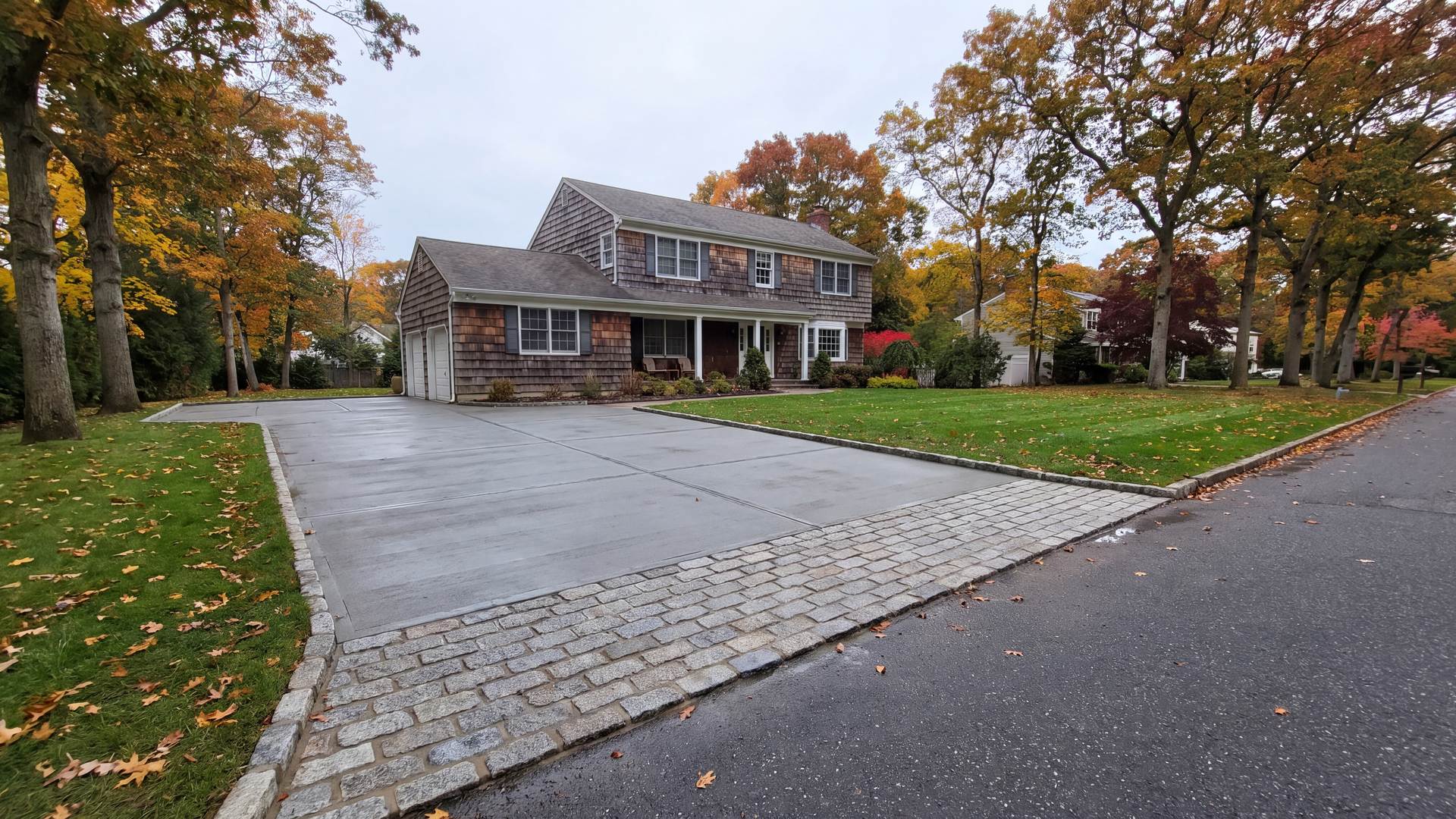
Concrete Contractor in Commack, NY
Commack is the largest place this site covers: the 2020 Census counted 36,536 people on 12.25 square miles, about 2,983 per square mile. That count covers the whole hamlet, which lies partly in the Town of Smithtown and partly in the Town of Huntington, and the split is the first thing to settle before concrete work starts. The state Department of State says every town administers and enforces the building code within its own jurisdiction, so the side of the line your house sits on decides which building department reviews a patio, pool or wall, and, on a town street, which highway office rules on the curb. Among the hamlet's landmarks is the Commack Methodist Church, built in 1789 as the Comac Church and the oldest Methodist church building in New York State.
No place this site covers has a larger share of homes built before 1980. Census estimates put 10,049 of Commack's 11,878 homes, about 84.6%, before 1980, and 5,233, about 44.1%, in the 1960s alone; the median year built is 1964. The 1950s and 1960s together account for 8,586 homes, about 72.3%. A driveway, walk or pool surround poured with one of those houses is as old as the house, so the questions that follow are whether a sunken slab can be lifted instead of replaced, and what a rebuilt pool deck has to meet.
Free quote
Which Town Owns Your Side of Commack, and Which Road Owns Your Curb
The town line decides the rulebook. On the Smithtown side, building permits come from the Town of Smithtown's Chief Building Inspector under Chapter 112, and the Town's zoning applies: paving is capped at 25% of each required front, side or rear yard, with extra room for a circular driveway and for a side-yard driveway to a garage (Section 322-12I(8)); front-yard parking must be on pavement; and paving stays at least one foot off side and rear lot lines. Stormwater has to be stored and disposed of on the lot (Section 322-25). On the Huntington side, the Town of Huntington enforces the state code, and work in its right-of-way needs a permit from the Huntington Highway Office. A plan drawn for one side will not necessarily pass on the other, so the town has to be settled before the design is.
The two towns also treat the strip at the street differently. On a Smithtown street, the apron, the part of the driveway between the curb and the property line, needs a highway work permit from the Superintendent of Highways (Section 245-15) with a certificate of insurance naming the Town (Section 245-19), and if the work opens the road, the Town will not permit it on a street it resurfaced in the prior three calendar years, or five for a new or rebuilt road (Section 245-16D). Huntington's Highway Office says anything other than concrete or asphalt in the right-of-way, naming Belgian block, pavers and light fixtures, requires a hold harmless agreement submitted with Suffolk County. So a Huntington-side plan for a block-edged apron carries that extra agreement, and on the Smithtown side, ask the Highway Department about block before it goes past the property line.
Two roads through Commack belong to the county, and a county road takes the county's permit whichever town the house is in. Commack Road is County Route 4: the Legislature took up a 2017 resolution to fund improvements to it in the hamlets of Deer Park, Brentwood, Commack and Dix Hills, and a 2018 resolution covered resurfacing from near Julia Circle to Route 25. County Route 14, Harned Road and Indian Head Road, runs from Jericho Turnpike in Commack north to Route 25A in Kings Park, and Motor Parkway is also a county road, County Route 67. A new or changed driveway on a county road needs Suffolk County's Non-Utility Highway Work Permit under Highway Law Section 136. Jericho Turnpike itself is State Route 25, so a driveway onto it goes to NYSDOT, and the state's July 2026 transportation announcement placed its junction with County Route 14 in the Town of Smithtown. The apron and sidewalk page covers the build.
On a Commack lot, where most homes date to the 1950s and 1960s, the first decision on a sunken driveway or walk is lift or replace. A slab that is whole or broken into large pieces can often be raised; shattered concrete should be replaced. Polyurethane foam goes in through holes of 3/8 to 5/8 inch, weighs 2 to 4 pounds per cubic foot and is ready for traffic in about 15 minutes. Mudjacking slurry needs holes of 1 to 2 inches, weighs over 100 pounds per cubic foot and takes 24 to 48 hours to cure, and that weight can add to future settling where the soil below is unstable. With foam, a slab should rise in small steps, no more than 1/4 inch from one injection point, with holes about three to five feet apart on a large slab. When a Commack driveway is past lifting, a replacement driveway should get joints about every 10 feet on a 4-inch slab and a centerline joint if it is wider than 12 feet.
A deck around an older pool is its own project. On the Smithtown side, the Town requires a permit from the Chief Building Inspector to build, install, enlarge or alter any pool (Section 322-17A), keeps pool water on the owner's land (Section 322-17C), and requires a barrier that meets the state code (Section 322-17D). Under the 2025 state rules, that barrier stands at least 48 inches high with no more than 2 inches of clearance at the bottom, and gates close on their own, with pedestrian gates opening away from the pool. Ask the Building Department whether replacing the deck needs its own permit before the old one comes out. For the slab, a pool industry draft standard asks for slip-resisting surfaces and a slope of at least 1/8 inch per foot away from the water on textured or hand-finished concrete, and a pool structural engineering firm calls for a full-depth flexible mastic joint at the coping, with no steel tying the deck to the bond beam at the top of the pool wall. The pool deck page covers finishes and joints.
See Commack, NY on Google Maps — we cover the whole area from Smithtown.
Concrete Contractor Services Available in Commack
Every service on this site is available in Commack at the same typical ranges:
See the full pricing guide for typical ranges.
Commack FAQs
How can I tell whether my Commack house is on the Smithtown or Huntington side?
Not from the mailing address. Commack's ZIP code, 11725, does not show the town, and school district lines do not follow the town line either: the Commack School District serves the vast majority of the hamlet, while small parts go to the Northport-East Northport, Hauppauge, Smithtown and Kings Park districts. Before plans are drawn, ask the Town of Smithtown Building Department to confirm whether the parcel is in the Town. The state assigns building code enforcement to each town within its own borders, so the town decides which building department reviews the plans.
Who approves a new driveway apron on Commack Road?
Suffolk County. Commack Road is County Route 4, and any modification in a county right-of-way needs the county's Non-Utility Highway Work Permit, handled by the Department of Public Works Permits Section at the H. Lee Dennison Building, 100 Veterans Memorial Highway, Hauppauge. County Code Section 948-14 spares a single home the review fee and the 10% of value fee, but the county requires general liability, workers compensation and disability insurance, and the work must meet county and current NYSDOT standards. The same county permit applies on either side of the town line.
Is it worth lifting a sunken 1960s driveway in Commack, or should it be replaced?
Lifting is worth pricing first if the slab is whole or in large pieces; shattered concrete should be replaced. One equipment maker claims a service life of 20 years or more for polyurethane foam and 5 to 10 years for mudjacking, depending on soil and water exposure, though that is a manufacturer's figure. Where the soil below is unstable, heavy slurry can add to the settling, which favors foam or a rebuild. If yours is one of the 5,233 Commack homes built in the 1960s, price both routes; the cost page shows the published ranges.
Get Your Free Commack Quote
Free quote