Concrete Contractor in Nesconset, NY
Nesconset is the most crowded place this site covers. The 2020 Census counted 13,207 people on 3.82 square miles of land, or 3,455.5 per square mile, against 2,163.6 for the Town of Smithtown as a whole. The Town lists Nesconset as one of its six hamlets, so no village government sits between you and the Town: the Town's Building Department and Highway Department handle a driveway, patio or apron, except on Route 347, where the state controls the curb. More people per square mile means tighter lots, so a wider driveway or a new patio reaches the Town's cap on paved yard area sooner, and the water shed by each new slab has less lawn to soak into before it reaches a lot line.
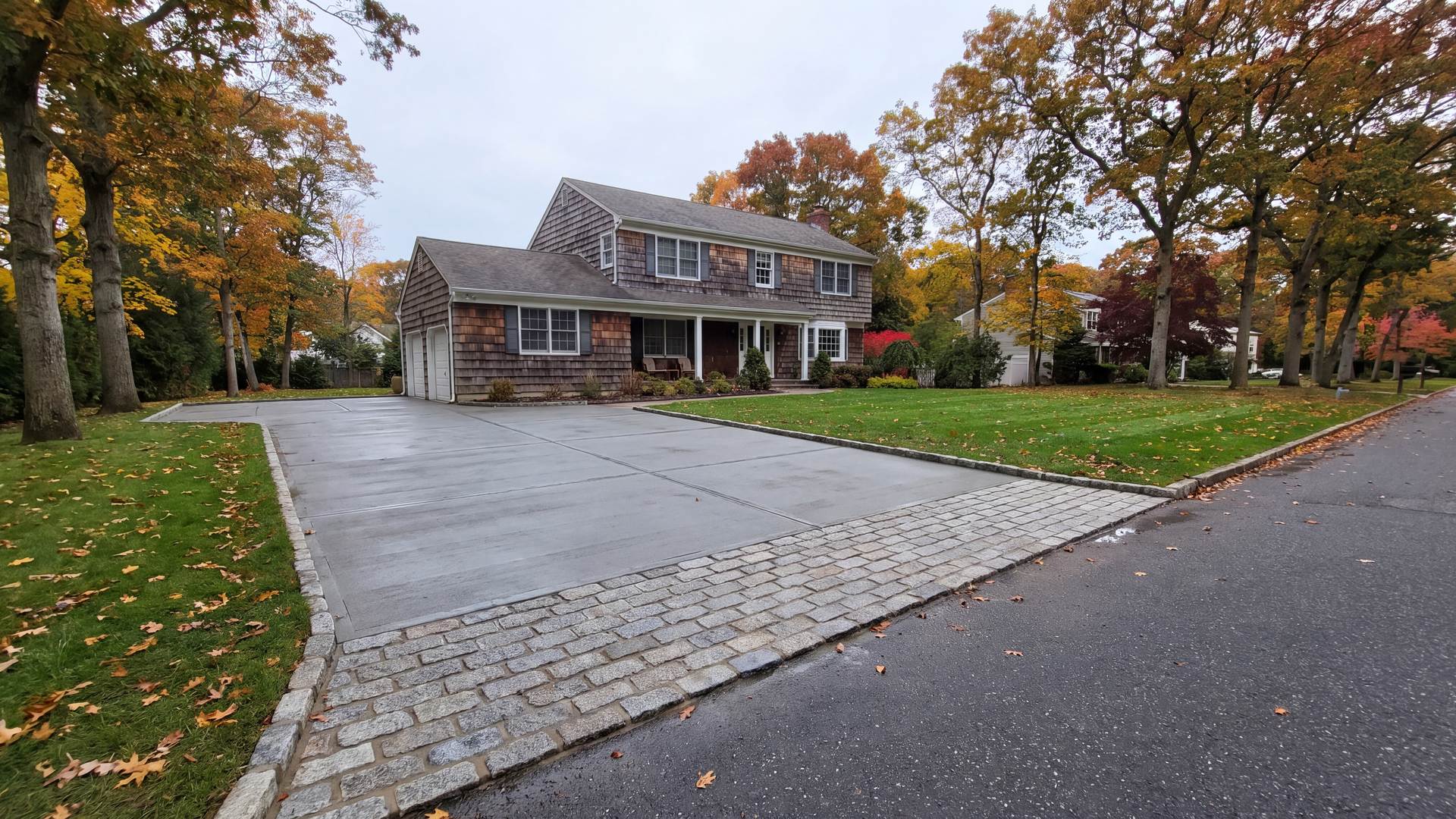
The houses are younger than the Town's as a whole. Census estimates put Nesconset's median year built at 1977, the newest of the eight places this site covers, against 1968 for the Town, and the 1970s were the busiest decade, with 1,240 of 4,704 homes. Route 347's construction in the 1950s opened this southeast corner of Smithtown to rapid suburban development. Even so, 2,771 homes, about 58.9%, predate 1980, which puts a driveway poured with the house near or past the half-century mark. When one that old is replaced, the rebuild is the chance to fix the joint layout and the base, and to count how much of the yard is already paved before a wider concrete driveway is drawn.
Free quote
Where the 25% Paving Cap Bites on Nesconset's Tighter Lots
The rule to check first on a Nesconset lot is Section 322-12I(8) of the Town zoning code: for houses, not more than 25% of the required front, side or rear yards may be paved. A required yard is the setback strip the zoning district keeps open between the house and each lot line, and on a tighter lot, 25% of it is not many square feet. A front walk, a side path to the gate and a patio in the rear setback all count, so the allowance can be spent before a new patio or walkway is even drawn. The front-yard limit grows as needed to fit a twelve-foot swath for a circular driveway, and one side yard can hold a driveway up to 10 feet wide to a detached garage, or be paved up to 50% for a side-entry garage. Paving must also stay at least one foot off the side and rear lot lines.
On Nesconset's tighter lots, the cap comes into play when you want room for another car. The same section bars parking or storing vehicles, trailers and boats in the required front yard except on paved surfaces, and Section 322-65B(1) calls for a stabilized, all-weather surface for residential parking. A driveway widened across the required front yard is paved surface there, so it counts against the 25%. Before anyone sizes the new slab, the estimate should measure the required yards and total the paving already on them. The Town's building code, Chapter 112, exempts only ordinary non-structural repairs and small sheds from permits, and paving is not on that short list, so ask the Building Department whether a widening needs a permit. If one is filed, Section 112-10D calls for a scaled plot plan showing distances from lot lines, which is where the 25% arithmetic gets checked.
Route 347, the Nesconset-Port Jefferson Highway, is a state highway; the state's corridor project on it, reported in 2022, runs between Gibbs Pond Road, the hamlet's western edge, and Hallock Road. Route 25 is a state road too. A driveway entrance onto either one is permitted by the New York State Department of Transportation, not the Town Highway Department. The state's entrance rules, 17 NYCRR Part 125, require a work permit for any driveway, accept applications only from the owner or an authorized agent, and ask for a sketch of the proposed driveway. The first 10 feet back from the edge of the travel lane must be paved, with at least four and one-half inches of cement concrete, or one and one-half inches of asphalt, on a six-inch gravel base, and a 12-foot width at a right angle to the road is the standard. After that, you maintain the apron out to the shoulder or curb, snow and ice included.
On a Town street in Nesconset, the apron, the part of the driveway between the curb and the property line, needs a highway work permit from the Superintendent of Highways under Chapter 245 of the Town Code (Section 245-15). The written application goes in with a certificate of insurance naming the Town (Section 245-19), work has to start within 30 days of the permit (Section 245-22A), and if the job opens the road itself, the Town will not permit it on a road it resurfaced in the prior three calendar years, or five for a new or rebuilt road (Section 245-16D). When the Town's own curb or apron has failed, you file a Notice of Defect with the Town Clerk, and the Highway Department records it and schedules the repair. The Town's subdivision standard (Section 248-37E) sets aprons at least 10 feet wide at the curb and 7 feet at the property line, and the apron and sidewalk page covers the build.
Under the lawn, the ground is glacial. Cornell Cooperative Extension names Riverhead sandy loam and Haven loam among Suffolk County's major soils, and the federal series descriptions call both very deep and well drained, formed in glacial outwash, with Haven's loamy upper layers over sand and gravel. The same soils come broken into patches, so which one lies under a given Nesconset lot is a question for a test hole. Sand drains fast, which helps a base, but concentrated water carries it off: a downspout aimed at a slab edge can wash fine material from under the concrete, and pavement guidance says the main job of a subbase is to prevent pumping or erosion of the subgrade. A walk that has dropped along a downspout line can often be raised if it is whole or in large pieces, so slab lifting is worth pricing before a tear-out.
See Nesconset, NY on Google Maps — we cover the whole area from Smithtown.
Concrete Contractor Services Available in Nesconset
Every service on this site is available in Nesconset at the same typical ranges:
See the full pricing guide for typical ranges.
Nesconset FAQs
How much of my Nesconset yard can be paved?
Section 322-12I(8) of the Town zoning code limits paving to 25% of each required front, side or rear yard on a residential lot, with extra room for a twelve-foot circular driveway swath and for a side-yard driveway to a garage, and paving stays at least one foot off side and rear lot lines. In the densest place this site covers, existing walks and patios can use up much of that allowance, so the estimate should measure the required yards and count what is already paved before a footprint is priced.
Can a Nesconset lot have a circular driveway?
The zoning code plans for one: on a residential lot, the front-yard paving limit grows as needed to fit a twelve-foot swath for a circular driveway. A circle means two curb cuts. On a Town street, the Highway Department's fee schedule prices driveway aprons per apron, so each opening is its own permit item. On Route 347, the state requires a work permit to provide an entrance or exit, with a sketch, and treats a 12-foot width as the standard. The plot plan should show both openings and their distance to each lot line.
Is a 1970s Nesconset driveway worth patching, or should it be replaced?
It depends on how it failed. A driveway poured with a 1977 house has been through decades of winters. NOAA's 1991-2020 normals for Long Island MacArthur Airport in Islip show a low of 32 degrees F or below on 98.3 nights a year but a high that stays that cold on only 16.4 days, so a slab freezes and thaws often; the Smithtown concrete data page has the full set. Settled sections that are whole can often be raised, and shattered concrete should be replaced. A new slab should be air-entrained, with tiny bubbles making up about 6% of the mix, and ordered at 4,000 psi where deicers will be used. The cost page lists what drives the price of a replacement.
Does a new patio behind my Nesconset house need a permit?
Ask the Town Building Department before the forms go down. Chapter 112 of the Town Code exempts only ordinary repairs that are not structural and sheds of 144 square feet or less, no taller than 12 feet, in a conforming location, and patios are not on that list. A patio in the required rear yard also counts toward the 25% paving cap, and paving must stay at least one foot off the rear and side lot lines. Section 322-25 requires the lot to keep its own stormwater, so the patio's pitch and where its runoff goes belong in the plan.
Get Your Free Nesconset Quote
Free quote