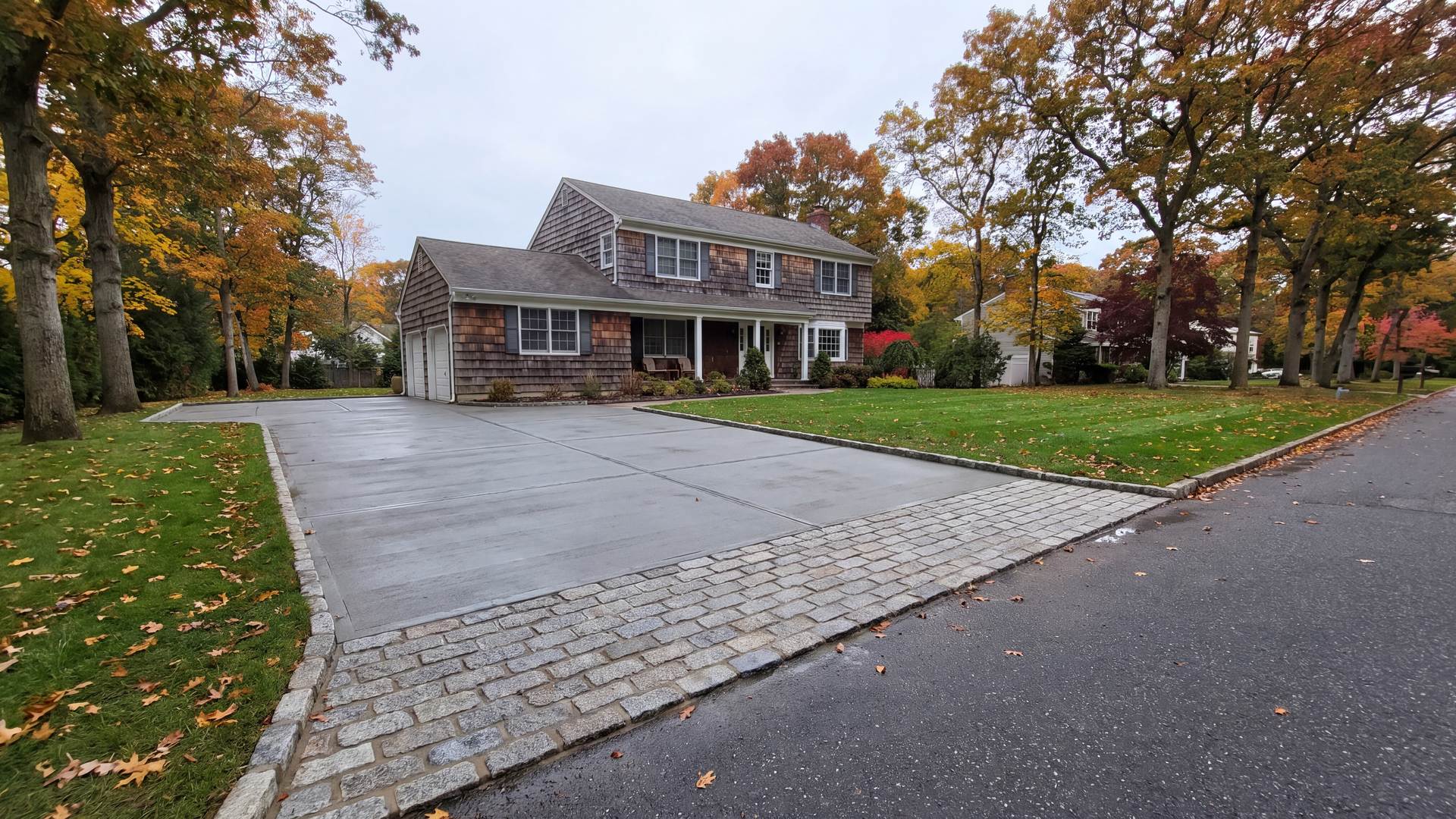
Concrete Contractor in Village of the Branch, NY
The Village of the Branch is the smallest of the eight places this site profiles, 0.950 square miles of land with 1,735 residents at the 2020 Census, and it issues its own permits. It incorporated in 1927, and the village's history names the main issue: the desire to establish a municipal water plant. It calls itself one of three incorporated villages within the Town of Smithtown, with a business district and a historic district, and its Village Hall is at 40 Route 111, open Tuesdays and Thursdays from 10:00 am to 2:00 pm. The Town of Smithtown's highway rules stop at the village line. The village has its own Code Enforcement Officer, appointed by the Board of Trustees under Section 112-3B, its own street and sidewalk chapter and its own zoning.
Nearly every home is owner-occupied, 537 of 545 occupied units, and the housing dates mostly from the middle of the last century: the median year built is 1967, the 1960s are the largest single decade at 187 of 597 homes, and 502 predate 1980. The oldest fabric is along Route 25, the Main Street that the village code calls Middle Country Road. The Village of Branch Historic District has been on the National Register since September 11, 1986, and a separate local Historic District sends exterior changes to the village Planning Board. The front of the lot is where the village code says the most: the public sidewalk and apron, the curb and curb cut, and the steps and stoop that face the street.
free quotes, fast response, local pros.
Free quote
The Village Code From the Curb Line to the Front Door
Village permits start with the building code. Section 112-4A requires a building permit for any work that must conform to the Uniform Code or the Energy Code. Section 112-4B exempts fences that are not part of a pool enclosure and retaining walls unless they support a surcharge, but Section 112-4C adds that an exemption does not authorize work that breaks either code. The village fee schedule as of July 2025 still lists a driveway permit and a fence permit as separate items at the same fee, prices new construction, additions and alterations per square foot, subject to a minimum, and charges three times the permit fee for work built before a permit was issued. Published prices for the concrete itself are on the cost page; village fees come on top of them.
Anything in the street or sidewalk runs through Chapter 234. Section 234-1 requires a permit from the village Superintendent of Highways for any excavation in a street, highway or sidewalk, and the fee schedule pairs a road excavation fee with a bond. Section 234-9 requires curbs and sidewalks to follow a grade obtained from the Village Engineer. Section 234-10A(1) makes residential sidewalks four feet wide and at least four inches thick, makes business-zone sidewalks at least five inches thick and covering the full area between the curb and the property line, and makes any sidewalk at least six inches thick through the width of a driveway that crosses it. Section 234-10A(2) sets curbs 18 inches deep and at least six inches thick in residential areas, eight in business areas, built in one course. Section 234-10B requires topsoil, roots, sod and broken concrete to come out to at least four inches below the new work, refilled with sand, gravel or cinders well tamped, and bars concrete on a frozen, soft or springy subgrade.
Curb cuts, the openings in the curb where a driveway meets the street, follow Section 234-11: none within 15 feet of the intersection of street property lines and at least 25 feet between cuts, unless the Superintendent of Public Works approves otherwise. Section 234-11C adds that on state and county roads, the approval of that road's authority must be presented before the village issues a curb cut permit. Routes 25, 25A and 111 all reach the village, and all three are state roads, so a curb cut on one of them starts with an NYSDOT work permit. The village's curb section is written in concrete terms, 18 inches deep and built in one course, so ask the Superintendent before planning Belgian block at the street. For edging along the private side of the driveway, the Belgian block page is the place to start.
The Branch sets a sidewalk snow deadline that the Town of Smithtown's sidewalk ordinance does not. Section 234-13A requires the owner or occupant to keep the sidewalk along the property free of obstructions and in good and safe repair, and to clear snow and ice within 24 hours after the snowfall stops or the ice forms. If that does not happen, the village may do the work and assess the cost against the property, and an unpaid charge becomes a tax on it. New concrete complicates the 24 hours. The Portland Cement Association says concrete placed late in the year should get no deicing chemicals its first winter, with sand used for traction instead, and NRMCA says never to use ammonium sulfate, ammonium nitrate or magnesium-based salts as a deicer. NOAA's Islip normals average 7.9 days a year with an inch or more of snow, so a walk poured in the fall means a first winter of shovel and sand.
The local Historic District has three parts under Section 275-46: the north side of Middle Country Road from North Country Road (Route 25A) to the village's east line, 600 feet deep; the south side from new Route 111 east to the village line, 400 feet deep; and 650 feet of the east side of new Route 111 south of Route 25, 400 feet deep. Under Section 275-57B, any building permit there that would change a structure's outside dimensions, front facade or appearance goes to the Planning Board first, which weighs its visual relationship to the district's character. Section 275-57 bars any new building whose style represents a period after 1850, and Section 275-58 bars any change to a building from before 1850 without a Board of Trustees resolution. The public sidewalk gets the wooden-float finish Section 234-10C requires, smooth but not slippery, so stamped and decorative concrete belongs on the private side: the front walk, the patio or the stoop landing.
In the Residence A district, Section 275-9 sets a minimum lot of 21,780 square feet, half an acre, Section 275-11 requires 100 feet of frontage, Section 275-12 sets the house at least 40 feet back from the street, and Section 275-10 caps buildings and structures of any kind at 25 percent of the lot. Section 275-17A then rules out a front-yard wall: no fence, wall or hedge may be erected or kept in the front yard of any premises unless the code provides otherwise or the Board of Zoning Appeals grants a special exception, and none anywhere may exceed six feet. On a corner lot, a fence in the secondary front yard sits 20 feet from the curb line. Because the front-yard rule does not carve out retaining walls, a grade change between the sidewalk and the house is a job for steps or a gentle slope unless the Board grants an exception.
See Village of the Branch, NY on Google Maps — we cover the whole area from Smithtown.
Concrete Contractor Services Available in Village of the Branch
Every service on this site is available in Village of the Branch at the same typical ranges:
See the full pricing guide for typical ranges.
Village of the Branch FAQs
Does my Village of the Branch driveway need its own permit?
The village's July 2025 fee schedule lists a driveway permit as its own item. If the work opens the street, the curb or the sidewalk, Section 234-1 also requires an excavation permit from the village Superintendent of Highways, and the schedule pairs road excavation with a bond. On Route 25, 25A or 111, Section 234-11C wants the state's approval presented before the village issues a curb cut permit. A Town of Smithtown apron permit does not apply here; the Town Code's Section 245-4 leaves out areas wholly within incorporated villages.
Does a new front stoop in the Historic District need Planning Board review?
If it changes the front of the house, yes. Steps are Uniform Code work, so Section 112-4A requires a building permit, and in the Historic District Section 275-57B refers any permit that would change a building's front facade or appearance to the Planning Board before it is issued. On a building from before 1850, Section 275-58 bars any change without a Board of Trustees resolution. The stair limits themselves are state rules; a Department of State bulletin on the 2017-era residential code caps risers at 8-1/4 inches and sets treads at 9 inches or more.
Who repairs the sidewalk and curb in front of my Branch house?
The owner or occupant. Section 234-14 makes it the duty of every property owner or occupant to keep the sidewalk and curb along the premises in a safe, passable condition, and if repairs are not made after notice from the Superintendent of Public Works, the Board of Trustees may have the work done and assess the cost on the property. The new work is built to Chapter 234, to a grade set by the Village Engineer.
Get Your Free Village of the Branch Quote
Free quote